
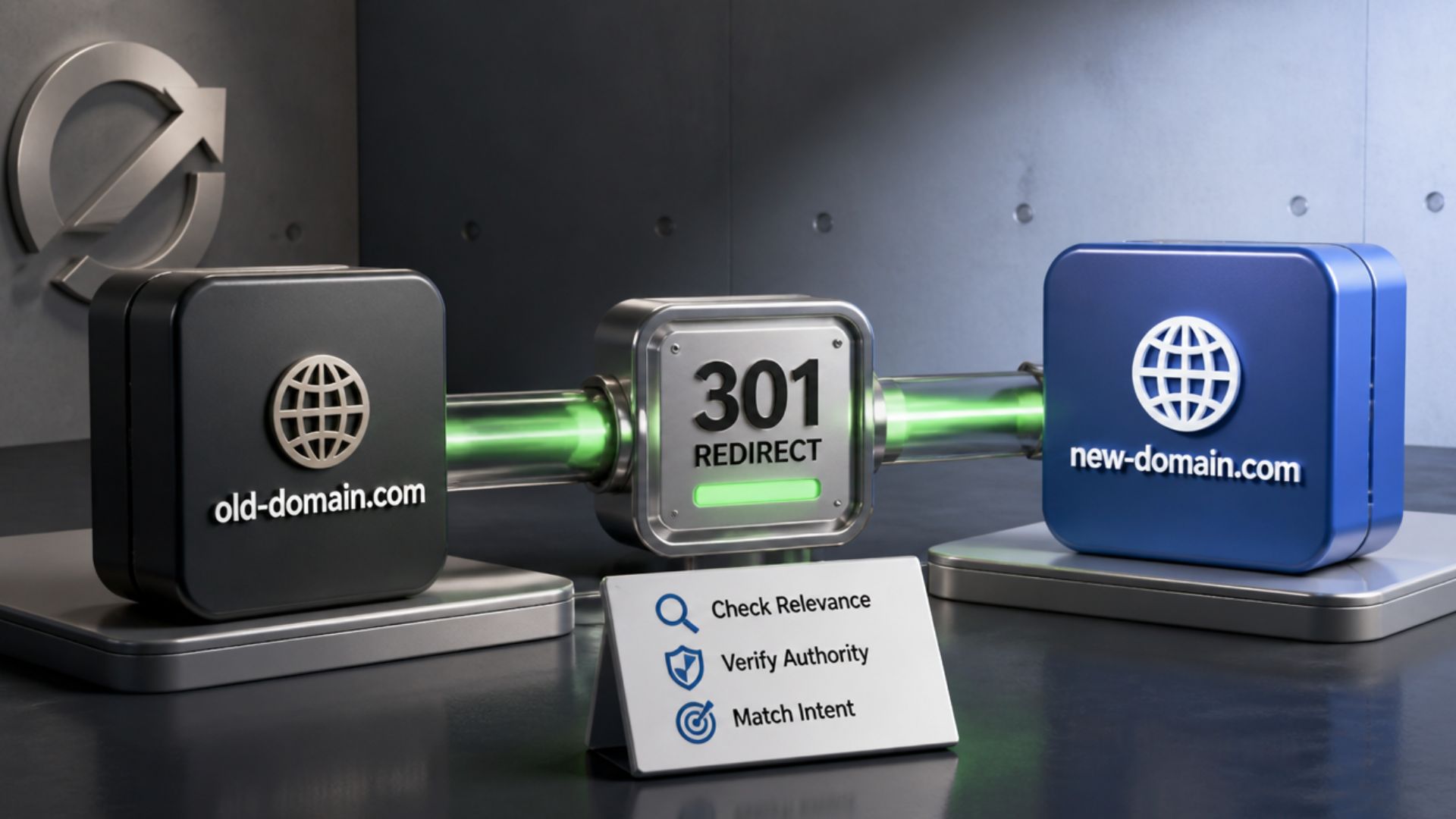
Finding a domain with a strong backlink profile can make a 301 redirect look like an easy SEO opportunity. But impressive metrics alone do not tell you whether the purchase makes sense. A domain may have plenty of links yet come from an unrelated topic, have a questionable history, or lack a relevant destination on your website. Choosing the wrong one can leave you with little practical value for the money spent. A better approach is to evaluate each candidate carefully before buying it, so the redirect has a clear, relevant purpose.
What Makes a Domain Suitable for 301 Redirection?
Not every expired domain with a strong backlink profile is a good candidate for a 301 redirect. The useful ones have a clear connection between what the site was, the links it earned, and where you plan to send visitors and search signals.
Before looking at individual metrics, establish a basic fit. A strong candidate should generally have:
- Relevant historical content that relates to your website or a specific destination.
- Legitimate backlinks from real, relevant websites rather than obvious link schemes.
- A clean history without prolonged spam, hacked content, or unrelated use.
- Valuable URLs that earned meaningful links or search visibility.
- A logical destination where the redirect provides a useful path for users.
Apply this first before spending time on detailed backlink metrics. If the site’s history and your intended use have little in common, a high authority score is unlikely to make it a sensible choice.
Check the Domain’s Historical Relevance
Before evaluating backlinks or SEO metrics, find out what the website was actually about. A domain that previously covered a subject closely related to your site is generally a more logical candidate than one that has changed topics several times. Use the Wayback Machine to review snapshots from different periods, rather than relying on the most recent version alone. This helps reveal whether the site’s topic was consistent and whether its history matches the redirect’s purpose.
Pay particular attention to major changes in what the site published. A domain that once belonged to a legitimate business but later hosted unrelated content, thin pages, or obvious spam deserves closer scrutiny. Look for a history that gives you a clear reason to connect the old site with your current website or a specific destination.
When reviewing its history, check for:
- Consistent subject matter across multiple years
- Major changes in purpose or ownership
- Periods of unrelated or low-quality content
- Signs of spam, hacked pages, or unusual publishing activity
- Historical pages that still have a relevant equivalent on your site
Analyze the Backlink Profile
A strong backlink profile is more useful when you understand where the links come from and why you earned them. Start by looking beyond the total number of backlinks. A candidate with thousands of links may have most of them coming from a small group of low-quality sites, while another with fewer links may have mentions from established websites that are genuinely relevant to its subject.
Focus on the quality and context of the referring domains. Look for legitimate, relevant, independently useful websites, and examine the pages where their links appear. Be cautious when you find large numbers of links that appear automated, sitewide, unrelated to the old site’s topic, or concentrated among sites that exist mainly to publish links.
Key checks include:
- Referring-domain quality: Are the linking sites credible and legitimate?
- Topical relevance: Do their subjects relate to the old website?
- Link placement: Were links earned within useful editorial content?
- Referring-domain diversity: Does the profile rely on many independent websites?
- Link patterns: Are there obvious signs of automated or manipulative link building?
Find the Domain’s Most Valuable Historical URLs
A domain can have a strong overall backlink profile while most of its useful links point to only a few pages. That makes it important to identify which historical URLs actually earned those links before deciding whether the acquisition makes sense. Look for pages that attracted relevant referring domains, meaningful organic visibility, or citations because of useful content, research, tools, or resources.
Once you identify those pages, compare them with your website’s content. The strongest candidates are those where an old URL has a clear and relevant equivalent on your site. If the pages that earned the important links have no logical destination, the domain’s apparent value may be much lower than its headline metrics suggest.
Check Organic Traffic and Search Visibility
Historical organic traffic can help you determine whether a site attracted genuine search visitors before it expired. Look at traffic trends over time rather than treating one high point as proof of value. A steady pattern around relevant topics is more useful than a sudden spike that may have come from a temporary event, viral page, or other source unrelated to the site’s long-term search presence.
Also review the keywords and pages that generated that visibility. If the site ranked for subjects closely related to your website, that supports the overall case for the candidate. However, traffic should remain a supporting signal, not the deciding factor. Search visibility can disappear for many reasons, and historical traffic alone does not guarantee that a 301 redirect will produce an SEO benefit.
Investigate Spam and Previous Abuse
A clean-looking backlink profile is not enough if the website itself has a problematic past. Review its history for periods when it hosted unrelated content, large amounts of low-quality pages, hacked material, or obvious spam. These issues matter because they can reveal that the site was previously used for purposes very different from the one you intend to support.

You should also consider Google’s current expired domain abuse policy. Google describes this as acquiring an expired domain and repurposing it primarily to manipulate Search rankings with content that provides little value to users. The fact that a domain has expired does not automatically make it problematic, but using one solely as a shortcut for ranking signals is a different situation from a legitimate, relevant site consolidation.
Make Sure the Domain Has a Relevant Destination
Before purchasing a candidate, decide where its traffic, links, and historical relevance would logically lead on your website. A redirect works best when the old content and the new destination serve a similar purpose. For example, an old article about a specific service is more naturally redirected to a comparable service page or resource than to the homepage simply because it is the easiest option.
If you cannot identify a relevant destination, that should influence your buying decision. Sending unrelated URLs to the homepage or another loosely connected page does not recreate the value of the original content and can create a poor experience for visitors. Google recommends redirecting old URLs to appropriate new URLs rather than using irrelevant destinations, particularly when handling site moves and URL changes.
Prefer Relevant Page-to-Page Redirects Over Blanket Redirects
When the old site has several useful pages, redirecting each one to its closest relevant counterpart is usually more sensible than sending everything to the homepage. An old guide can point to a related guide, while an old service page can point to the corresponding service on the new site. This preserves a clearer connection between what the visitor expected to find and where the redirect takes them.
A blanket redirect can still be appropriate when the entire site has a close equivalent on the new website. The important part is that the destination should make sense for the source URL. Google recommends mapping old URLs to relevant new URLs during site moves and warns that redirecting many unrelated URLs to one destination, such as the homepage, can be treated as a soft 404.
Set Up and Verify the 301 Correctly
Once you’ve selected a suitable candidate and identified the right destination, implement the redirect as a permanent server-side redirect. Each source URL should point directly to its intended final destination, rather than passing through another URL first. After implementation, test the redirects to confirm they return the expected HTTP status and reach the correct page.
Also check the site for redirect chains, loops, broken destinations, or URLs that lead to irrelevant pages. After the redirects are live, monitor the site in Google Search Console and review traffic and indexing for unexpected changes. Google recommends using permanent redirects such as 301 or 308 for permanent moves and keeping redirect chains to a minimum.
When You Should Walk Away From a Domain
Not every candidate is worth buying, even if its metrics initially look attractive. The strongest reason to reject one is a clear mismatch between its history, backlink profile, and intended use. Don’t let a high DR, large backlink count, or low purchase price outweigh problems that could make the redirect irrelevant or difficult to justify.
Walk away when:
- The historical topic is unrelated to your website or intended destination.
- The strongest backlinks are irrelevant or come from questionable sources.
- The backlink profile shows obvious manipulation, such as unnatural anchor patterns or large amounts of low-quality links.
- The site has a serious spam or abuse history that cannot be reasonably explained.
- Its valuable historical URLs have no relevant counterparts on your website.
- There is no sensible destination for the redirect.
- The main reason to buy it is a high SEO metric, rather than a clear strategic fit.
- The cost and effort outweigh the potential value your research supports.
A candidate does not need to be perfect, but you should be able to explain why its history, links, and intended destination fit together. If you cannot make that case after checking the evidence, passing on the purchase is usually the safer decision.
Conclusion
Choosing a domain for a 301 redirect is less about finding the highest authority metric and more about finding a strong match between the old site and your own. Review its history, backlink profile, anchor text, valuable URLs, and search visibility before deciding whether it is worth buying. Just as importantly, make sure those signals have a relevant destination on your website.
A good candidate should have a clear reason to be connected to your site. If the history, links, and intended redirect do not line up, the safer choice is to keep looking. A careful evaluation before purchase can help you avoid paying for an asset that looks valuable on paper but offers little practical SEO value.