
Every website owner knows that domain names must be renewed annually, but few fully understand what happens when that renewal gets missed. The process is not as simple as a domain disappearing the moment it expires. Instead, a structured sequence of grace periods kicks in, each designed to give the owner progressively fewer options to recover their name. One of the most consequential stages in this sequence is the domain redemption period, a narrow window of time that can mean the difference between reclaiming an important web address and losing it permanently.
The domain redemption period sits near the end of the expiration lifecycle, after the standard renewal window has already closed. At this stage, the domain is pulled from active use, meaning the website goes dark and email stops working, but the name is still technically held under the original owner’s identity. No one else can register it, but the cost to reclaim it jumps considerably compared to a normal renewal. Knowing exactly how this stage works, what it costs, and what happens after it closes can save domain owners from costly mistakes.
The Full Domain Expiration Timeline
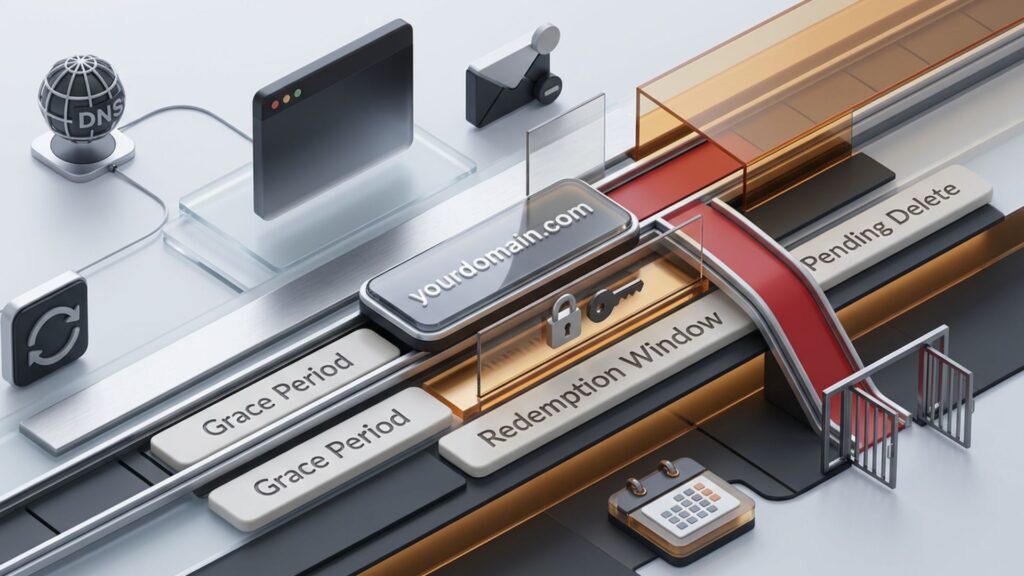
To understand the redemption period properly, it helps to see where it falls within the broader lifecycle of an expiring domain. When a domain’s registration date passes without renewal, the sequence begins at day zero. Most registrars automatically enter the domain into an initial grace period lasting roughly 30 to 45 days. During this window, the owner can renew at the standard annual price with no extra penalties, though the website and associated email services may already be offline depending on the registrar.
If that grace period passes without action, the registrar typically submits a deletion request to the domain registry. This is the trigger that moves the domain into the Redemption Grace Period (RGP), which lasts 30 days. During this time, the domain carries a special status code visible in public WHOIS records, a flag that tells the internet infrastructure that this name is in a recovery state and cannot be transferred or registered by anyone other than the original owner.
After the 30-day redemption window closes without action, the domain moves into a “Pending Delete” phase that lasts approximately five days. There is absolutely no recovery option during this phase. Once those five days elapse, the registry releases the domain and it becomes available for anyone to register, either through standard open registration or through a domain auction platform.
The entire process from expiration to public availability typically spans around 70 to 75 days, depending on the registrar and TLD. That timeline, while it may seem generous, moves faster than most people expect when they are not paying close attention.
How the Redemption Grace Period Was Established
The Redemption Grace Period was formally established by ICANN, the Internet Corporation for Assigned Names and Numbers, which oversees the global domain name system. ICANN introduced the RGP policy to address a real problem: domain names were sometimes being accidentally deleted by registrars or registrants, with no clear mechanism for recovery. Without a standardized redemption window, a single clerical error or a missed payment could permanently erase a domain that represented years of brand equity and search presence.
The ICANN policy requires all accredited registrars managing generic top-level domains (gTLDs) to offer the 30-day redemption window once a deletion has been initiated. This obligation sits under the broader Expired Registration Recovery Policy (ERRP). The policy specifies that a registrar cannot refuse to allow redemption during this period. If a registrar blocks a legitimate redemption attempt, they can be considered in breach of their ICANN accreditation agreement.
Registrars are also required under ICANN’s ERRP to send renewal reminder notices to the registrant at specific intervals: approximately one month before expiration, about one week before expiration, and again within five days after expiration. These notice requirements exist specifically to reduce the number of domains that fall into redemption due to simple oversight rather than intentional non-renewal.
What Actually Happens to Your Domain During Redemption
When a domain enters the redemption period, it is placed into a suspended state at the registry level. The domain’s DNS records are typically removed or deactivated, which means any website hosted on that domain stops loading, and any email addresses tied to that domain stop functioning. From a visitor’s perspective, the domain simply does not exist during this period.
If the domain remains inaccessible for an extended period, websites linking to it may eventually remove or update those references. Recovering those lost backlinks later often requires link reclamation, a process that helps restore valuable external links that no longer point to active content.
The EPP (Extensible Provisioning Protocol) status code assigned to the domain changes to “redemptionPeriod,” a technical marker that tells registrars and registries the domain is in the recovery window. This status is publicly visible in WHOIS lookups, which is useful because it tells domain investors and buyers that the name may soon be available, and it also confirms to the current owner that recovery is still possible.
One important detail is that domain transfers are blocked during the redemption period. If an owner wants to move the domain to a different registrar after recovering it, they must first restore it through the current registrar, pay any applicable fees, and wait until the domain returns to active status before initiating a transfer. Attempting to skip this step will fail at the registry level.
The Cost of Recovering a Domain in Redemption
Redemption fees vary widely across registrars, and the difference can be significant. The fee structure exists because the registrar must submit a special restore request to the registry on the owner’s behalf, a process that involves additional administrative work and registry-level charges. For most generic TLDs like .com, .net, and .org, the registry charges the registrar a fixed restore fee, which registrars then pass on to the customer, often with a markup.
In practical terms, redemption recovery commonly costs between $80 and $250 on top of the regular annual renewal fee, depending on the registrar. For example, some well-known providers charge around $80 to $100 for the redemption fee alone, while others set it closer to $150 or more. Enom, one of the larger wholesale registrars, lists its redemption recovery fee at $250, making it one of the pricier options in the industry.
It is worth comparing these costs to the domain’s actual value before committing to redemption. For a common .com domain used by an established business, paying a $150 redemption fee to avoid rebuilding SEO authority and brand recognition is almost always worth it. For a domain that was registered casually with no significant history, it may be more practical to simply re-register it once it drops, provided no one else registers it first.
For organizations managing several brands or regional websites, buying multiple domain names can also reduce the risk of losing important digital assets while helping protect brand identity across different markets.
How TLD Type Affects the Redemption Process
The 30-day redemption window described by ICANN applies specifically to generic top-level domains like .com, .net, .org, .info, and newer gTLDs such as .xyz or .online. Country-code top-level domains (ccTLDs), things like .uk, .de, .au, and .ca, are managed by their own national registries and are not required to follow ICANN’s RGP rules. This creates meaningful variation in how expired domains are handled across different extensions.
The .uk domain, managed by Nominet, follows a different expiration process entirely. Domains under .uk go through a suspension period and then enter a 30-day renewal period before being cancelled, but the formal “redemption” mechanism familiar from ICANN gTLDs does not apply in the same way. The .de domain, managed by DENIC, operates under similarly distinct rules and can be released for re-registration faster than ICANN timelines would suggest. Owners of ccTLD domains should always consult the specific registry’s documentation rather than assuming the standard gTLD process applies.
Even among ICANN-regulated gTLDs, newer extensions sometimes apply different fee structures or redemption durations. Registries for newer TLDs have more flexibility in how they configure their expiration policies, so a .photography domain and a .com domain may behave differently in the days after expiration even though both fall under ICANN oversight.
Practical Steps to Recover a Domain in Redemption
Recovering a domain during the redemption period requires working directly through the registrar where the domain was originally registered. The process cannot be completed through a different registrar until after the domain has been restored to active status. The first step is logging into the original registrar account and checking the domain’s current status, which should show the redemption flag alongside an option to initiate a restore request.
After submitting the restore request, the registrar sends a command to the domain registry to reverse the deletion and reinstate the domain’s registration. This process takes time, commonly anywhere from a few hours to a couple of business days, depending on the registrar’s systems and the registry involved. During this processing window, the domain remains offline, so businesses relying on email or website availability will need to communicate with their contacts through alternative channels.
Payment must be completed before or during the restore request. Most registrars require the redemption fee and at least one year of renewal to be paid upfront. Once the payment clears and the registry confirms the restore, the domain returns to active status, and the owner can update DNS records to bring their site and email back online.
Keeping Your Domain Out of the Redemption Period
The simplest protection against ever dealing with a redemption fee is enabling auto-renewal through the registrar. Nearly every registrar offers this feature, and it automatically charges the renewal cost to the payment method on file before the domain expires. Keeping a valid, current payment method attached to the account is essential because an expired credit card will cause auto-renewal to fail even when the feature is enabled.
Registering a domain for multiple years at once also reduces risk. ICANN rules allow most gTLDs to be registered for up to ten years at a time, and paying for a longer registration period eliminates the annual renewal cycle for that stretch of time. Beyond the administrative convenience, multi-year registrations also lock in the current renewal rate with some registrars, offering a degree of cost protection.
Accurate contact details in the registrar account matter more than most people realize. ICANN policy requires registrars to send expiration and post-expiration notices, but those notices are only useful if they reach an active email address. If the email address on the account is outdated or abandoned, every warning that ICANN mandates will land in an inbox nobody reads.
The Moment the Window Closes
Once a domain exits the redemption period and enters the Pending Delete phase, no amount of money or urgency can bring it back through the original registrar. At that point, the only path to reclaiming the domain is waiting for it to be released and then registering it again through normal channels, or bidding on it if it surfaces at a domain auction. There is no guarantee the name will be available, and businesses or individuals who built their identity around a specific domain can find themselves in a difficult position if a competitor or domain investor registers it first.
If the original domain cannot be recovered, some website owners evaluate high DR domains as an alternative starting point, provided the domain has a clean history and backlinks that are relevant to their niche.
The redemption period exists precisely to prevent this outcome. It is a structured safety net, one that comes with a real financial cost but that is almost always cheaper than the alternative of starting over with a new domain.